
Best Ingredients for Dark Spots & Uneven Skin Tone: Vitamin C, Niacinamide & More
Uneven skin tone, dark spots, acne marks, and hyperpigmentation are common skincare concerns. But with hundreds of products marketed as “brightening,” “whitening,” or “spot correcting,” it can be difficult to know which skin brightening ingredients are actually useful.
The goal of a good brightening skincare routine is not to change your natural skin color. Instead, the focus should be on reducing the appearance of hyperpigmentation, dark spots, post-acne marks, and uneven skin tone while protecting the skin from further pigmentation.
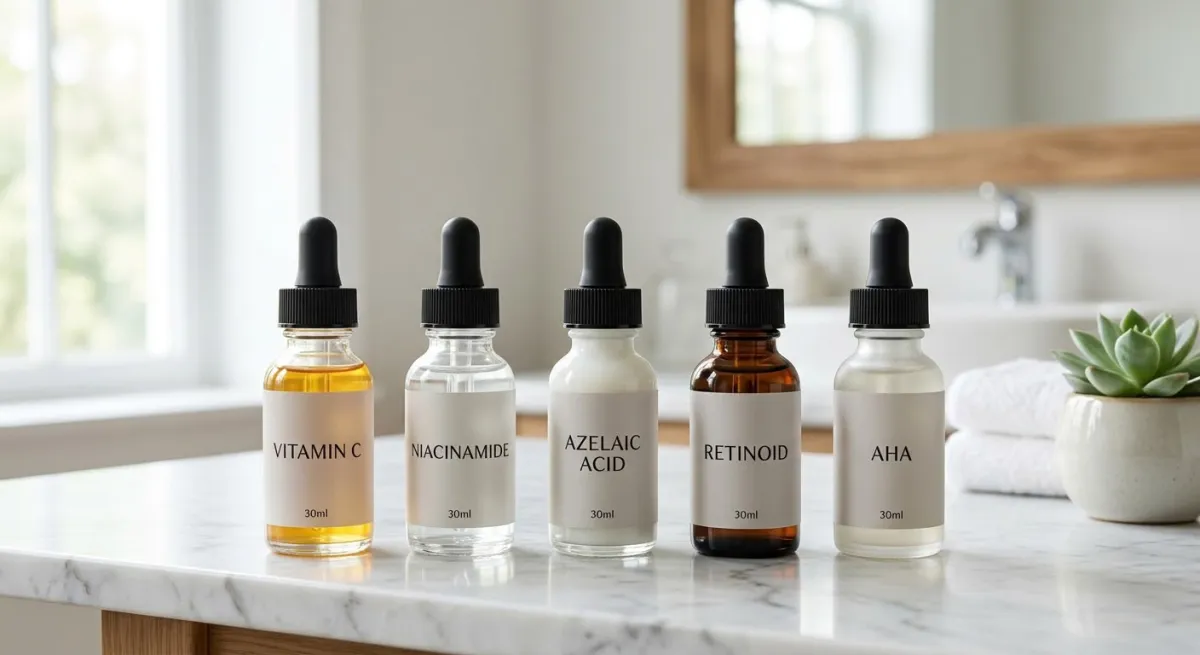
Some ingredients have evidence for helping improve the appearance of dark spots, including vitamin C, niacinamide, azelaic acid, retinoids, glycolic acid, and other alpha hydroxy acids (AHAs). Sunscreen is also an essential part of managing pigmentation because UV and visible light can contribute to darkening.
However, results take time. Using several strong active ingredients at once can irritate the skin, and irritation may make pigmentation more noticeable in some people.
What Causes Dark Spots and Uneven Skin Tone?
Before choosing a dark spot treatment, it is important to understand that pigmentation can have different causes.
Dark spots and uneven skin tone may appear after:
- Acne or pimples
- Skin inflammation
- Minor injuries or irritation
- Sun exposure
- Melasma
- Certain medications
- Some underlying skin conditions
Post-acne marks are often a type of post-inflammatory hyperpigmentation (PIH). Treating the underlying acne and preventing additional irritation can therefore be an important part of improving the appearance of these marks.
Because different types of pigmentation have different causes, there is no single “best” ingredient for everyone.
1. Vitamin C for Dark Spots and Uneven Skin Tone
Vitamin C is one of the most popular ingredients in brightening skincare.
It is an antioxidant and is commonly used in products designed to improve the appearance of uneven skin tone and pigmentation.
Vitamin C may help improve the appearance of dark spots while providing antioxidant activity against environmental oxidative stress.
However, vitamin C products are not all the same. Different formulations can vary in:
- Concentration
- Stability
- Form of vitamin C
- Product formulation
- Skin tolerability
Some people experience irritation, dryness, or stinging, especially with stronger formulations.
If you are new to vitamin C skincare, start with one product and introduce it gradually rather than adding several active ingredients at the same time.
2. Niacinamide for Hyperpigmentation
Niacinamide, also known as nicotinamide, is a form of vitamin B3 commonly used in skincare.
It is used in products designed to support the skin barrier and improve the appearance of uneven skin tone.
For people looking for a relatively simple skincare routine for dark spots, niacinamide can be an option because it can fit into a basic routine without requiring several different active ingredients.
As with any skincare product, irritation or sensitivity can occur.
If your skin becomes persistently red, itchy, burning, or uncomfortable after using a product, stop using it and consider getting professional advice.
3. Azelaic Acid for Dark Spots and Acne Marks
Azelaic acid is a topical ingredient used for acne and certain pigmentation concerns.
It also has anti-inflammatory properties, which can be useful when acne or inflammation is contributing to post-inflammatory hyperpigmentation.
This makes azelaic acid particularly relevant for people dealing with both acne and dark spots.
The American Academy of Dermatology lists azelaic acid among ingredients that may help fade dark spots.
Possible side effects can include:
- Burning
- Stinging
- Dryness
- Redness
- Irritation
Introduce it gradually and follow the instructions for the specific product. Prescription-strength products should be used according to your healthcare professional's advice.
4. Retinoids and Retinol for Skin Texture and Pigmentation
Retinoids are vitamin A derivatives used in dermatology for conditions such as acne and photoaging.
Some topical retinoids can also help improve the appearance of uneven pigmentation and skin texture over time. The AAD lists retinoids, including retinol, tretinoin, adapalene, and tazarotene, among ingredients that can help fade dark spots.
Retinoids can initially cause:
- Dryness
- Redness
- Peeling
- Irritation
- Increased sensitivity
Starting gradually and using an appropriate moisturizer can improve tolerability.
More is not necessarily better. Excessive irritation can make some pigmentation concerns more noticeable, particularly in people who are prone to post-inflammatory hyperpigmentation.
Can You Use Retinoids During Pregnancy?
If you are pregnant, planning pregnancy, or breastfeeding, discuss retinoid use with a qualified healthcare professional. Topical retinoids are generally avoided during pregnancy as a precaution.
5. Alpha Hydroxy Acids for Uneven Skin Tone
Alpha hydroxy acids (AHAs) are chemical exfoliating ingredients commonly used to improve skin texture and the appearance of some pigmentation.
Common AHAs include:
- Glycolic acid
- Lactic acid
Glycolic acid is also listed by the AAD as an ingredient that may help fade dark spots.
However, stronger concentrations and frequent exfoliation can irritate the skin.
Irritation can cause redness, dryness, burning, and increased sensitivity. For people who develop post-inflammatory hyperpigmentation easily, unnecessary irritation can make the overall pigmentation problem harder to manage.
For this reason, gradual use is generally more sensible than repeatedly applying strong exfoliating products.
6. Sunscreen Is Essential for Dark Spots
If you are trying to improve hyperpigmentation or dark spots, sunscreen should be a central part of your routine.
UV exposure can contribute to pigmentation and can make existing dark spots harder to fade.
The American Academy of Dermatology recommends a broad-spectrum, water-resistant sunscreen with SPF 30 or higher.
For people dealing with melasma or certain forms of hyperpigmentation, visible light can also contribute to skin darkening. The AAD notes that tinted sunscreens containing iron oxide can provide protection against visible light.
A Simple Sunscreen Routine
Apply sunscreen as the final step of your morning skincare routine before going outdoors.
For prolonged outdoor exposure, follow the product instructions for reapplication. Additional protection such as shade, protective clothing, and a hat can also reduce UV exposure.
If pigmentation is your main concern, sunscreen is not an optional extra—it is an important part of protecting the progress you are trying to make with other skincare ingredients.
7. Tinted Sunscreen for Hyperpigmentation
A tinted sunscreen with iron oxide may be particularly useful for people concerned about hyperpigmentation because it can provide protection against visible light as well as UV radiation.
This can be especially relevant for people with darker skin tones, for whom visible light can contribute to dark spots and melasma.
When choosing sunscreen for pigmentation, look for:
- Broad-spectrum protection
- SPF 30 or higher
- Water resistance when needed
- A formula suitable for your skin type
- Tint with iron oxide if visible-light protection is a concern
What Is the Best Ingredient for Dark Spots?
There is no single best ingredient for dark spots for every person.
The appropriate ingredient depends on:
- The cause of pigmentation
- Your skin type
- Whether you have acne
- Whether your skin is sensitive
- Whether you have melasma
- How severe the pigmentation is
- Whether the skin barrier is irritated
The AAD lists several options—including azelaic acid, glycolic acid, retinoids, and vitamin C—for fading dark spots, while treatment for conditions such as melasma may require a dermatologist-guided plan.
Therefore, choosing one suitable ingredient and using it consistently may be more practical than buying many brightening products.
Vitamin C vs Niacinamide for Dark Spots
Both vitamin C and niacinamide are popular skincare ingredients, but they serve somewhat different roles.
Vitamin C is an antioxidant commonly used for brightening and uneven skin tone.
Niacinamide is commonly used to support the skin barrier and improve the appearance of uneven skin tone.
You do not necessarily need to use both.
If you are new to active skincare ingredients, starting with one product makes it easier to determine how your skin responds.
Can You Use Multiple Brightening Ingredients Together?
Using multiple active ingredients does not automatically make a skincare routine more effective.
Combining:
- Vitamin C
- Retinoids
- AHAs
- Azelaic acid
- Other exfoliating products
without considering your skin's tolerance can increase irritation.
A simpler routine can be easier to maintain and may reduce the risk of over-exfoliation.
For more information about common routine mistakes, read:
[Why Your Skincare Routine Isn't Working: 8 Common Mistakes to Avoid]
A Simple Skincare Routine for Dark Spots
You do not need ten different products to build a hyperpigmentation skincare routine.
Morning Routine
- Gentle cleanser, if needed
- One suitable active ingredient, such as vitamin C
- Moisturizer
- Broad-spectrum SPF 30+ sunscreen
Evening Routine
- Gentle cleanser
- One treatment product, if appropriate
- Moisturizer
You can adjust this routine according to your skin type and the products you already use.
If you are using a retinoid or another potentially irritating treatment, introduce it gradually instead of adding several active ingredients at once.
How Long Does It Take for Dark Spots to Fade?
Dark spots usually do not disappear overnight.
The time required depends on the cause, depth of pigmentation, skin type, treatment, sun exposure, and whether the original trigger continues.
The American Academy of Dermatology notes that a spot only a few shades darker than the natural skin color may take around 6 to 12 months to fade on its own, while deeper discoloration can take considerably longer.
This is why consistent sunscreen use and a suitable skincare routine are important.
Be Careful With Skin-Whitening and Skin-Lightening Products
There is an important difference between improving the appearance of hyperpigmentation and trying to permanently change your natural skin color.
Be particularly careful with products marketed as:
- Skin whitening creams
- Bleaching creams
- Instant fairness creams
- Powerful spot removers
- Unlabeled brightening creams
- “Permanent whitening” products
Some illegally marketed skin-lightening products have been found to contain mercury or hydroquinone that was not appropriately disclosed.
The FDA warns that mercury-containing skin-lightening products can cause serious health problems, while hydroquinone-containing products can cause serious skin reactions and permanent discoloration in some cases.
Avoid products with unclear ingredients, missing labels, or dramatic claims about permanently changing your skin color.
If a product causes severe burning, swelling, blistering, or significant irritation, stop using it and seek medical advice.
Brightening Skin Does Not Mean Changing Your Natural Skin Color
A healthy skin brightening routine should focus on improving the appearance of:
- Dark spots
- Acne marks
- Uneven pigmentation
- Sun-related discoloration
- Dull-looking skin
The goal is to support more even-looking skin, not to change your natural complexion.
This distinction is important because aggressive skin-lightening practices can damage the skin barrier and, in some cases, cause lasting skin problems.
How Pollution Can Affect Pigmentation
Sun exposure is not the only environmental factor worth considering.
Air pollution has also been studied in relation to oxidative stress, inflammation, and skin-barrier changes.
For more information, read our related article:
[How Pollution Harms Your Skin & What to Do About It]
A practical routine for people exposed to polluted environments should still focus on gentle cleansing, moisturization, and UV protection rather than relying on products marketed as a complete “pollution shield.”
Morning vs Night Skincare for Dark Spots
Some skincare ingredients are more commonly used at particular times of day, while others can be used according to the product instructions and your skin's tolerance.
For example, sunscreen belongs in your daytime routine because its main purpose is UV protection.
If you want a simple explanation of how to organize products during the day and night, read:
[Morning vs Night Skincare: Does Timing Really Matter?]
A consistent routine is generally more useful than constantly changing products.
Common Mistakes When Treating Dark Spots
1. Skipping Sunscreen
Using a brightening serum while regularly exposing your skin to UV radiation can make it harder to manage pigmentation.
2. Using Too Many Active Ingredients
More acids and serums do not automatically mean faster results.
3. Exfoliating Too Often
Over-exfoliation can damage the skin barrier and increase irritation.
4. Changing Products Every Few Days
Most skincare ingredients need consistent use over time. Constantly switching products also makes it difficult to identify which ingredient is helping or irritating your skin.
5. Using Unlabeled Skin-Lightening Products
Products without clear ingredient information can carry unnecessary risks.
6. Expecting Overnight Results
Pigmentation often takes time to improve. Patience and consistency are important.
When Should You See a Dermatologist?
Not every dark patch has the same cause.
You should consider seeing a dermatologist if pigmentation is:
- Persistent
- Rapidly changing
- Unexplained
- Severe
- Associated with itching, pain, bleeding, or another unusual symptom
- Not improving despite a consistent basic skincare routine
A dermatologist can determine whether the pigmentation is related to acne, inflammation, melasma, medication, sun exposure, or another condition and can recommend appropriate treatment.
Frequently Asked Questions
What are the best ingredients for dark spots?
Commonly used ingredients include vitamin C, azelaic acid, glycolic acid, retinoids, and other ingredients selected according to the cause of pigmentation. Sunscreen is also essential because UV and visible light can contribute to dark spots.
Is vitamin C good for uneven skin tone?
Vitamin C is commonly used in skincare to improve the appearance of uneven skin tone and pigmentation. Different formulations vary in stability and tolerability, so results can differ between products.
Is niacinamide good for pigmentation?
Niacinamide is commonly used to support the skin barrier and improve the appearance of uneven skin tone. It can be a useful option for a simple skincare routine, although individual results vary.
What is better for acne marks: vitamin C or azelaic acid?
Both can have a role in a skincare routine, but the appropriate choice depends on the type of pigmentation, acne activity, skin sensitivity, and other products being used. Azelaic acid is specifically listed by the AAD among ingredients that may help fade dark spots.
Does sunscreen help dark spots?
Yes. Sunscreen helps protect skin from UV radiation that can contribute to pigmentation. For some people with hyperpigmentation or melasma, tinted sunscreen containing iron oxide may also help protect against visible light.
Can skin-lightening creams be harmful?
Some improperly labeled or illegally marketed products may contain harmful ingredients such as mercury or undisclosed hydroquinone. The FDA has warned consumers about serious risks associated with certain skin-lightening products.
The Takeaway
The most useful skin brightening ingredients are not necessarily the strongest ones.
Vitamin C, niacinamide, azelaic acid, retinoids, and AHAs can all have a role in managing the appearance of dark spots, hyperpigmentation, acne marks, and uneven skin tone, depending on the cause and individual skin tolerance.
A practical skincare routine for dark spots should focus on:
- Gentle cleansing
- Appropriate moisturization
- One or two suitable active ingredients
- Daily broad-spectrum SPF 30+ sunscreen
- Consistent use over time
- Avoiding unnecessary irritation
- Avoiding unregulated skin-lightening products
If pigmentation is persistent, severe, rapidly changing, or unexplained, professional evaluation is more appropriate than continuously adding new skincare products.



Leave a Comment